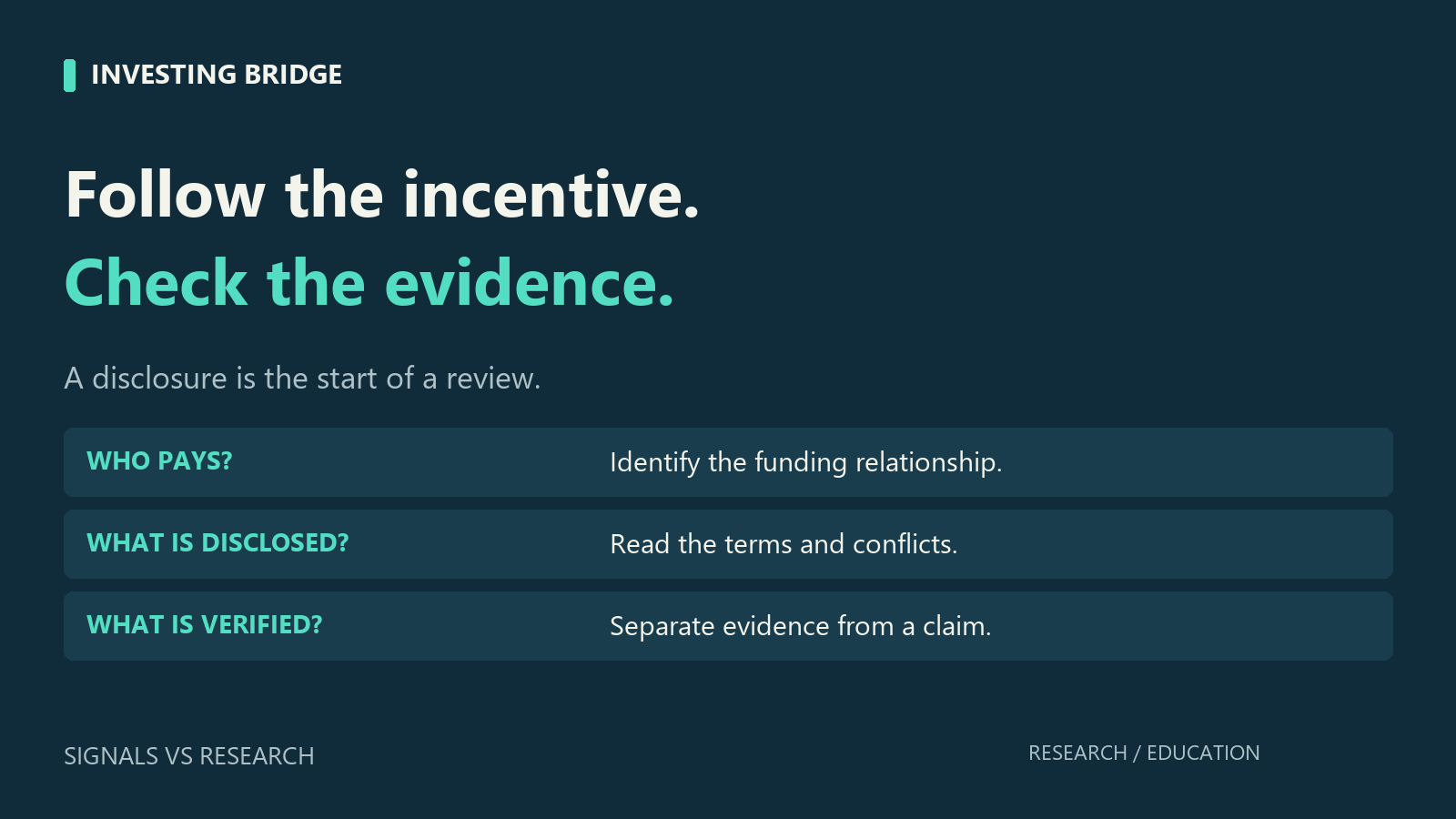

Signal subscription conflicts deserve scrutiny, but a disclosed financial relationship is not proof of misconduct. It is a reason to ask how a particular agreement works before deciding whether its claims and incentives are clear enough to evaluate.
When a subscription discusses trading ideas and also directs readers toward a broker, platform, course or other paid service, the reader may need to understand more than the subscription price. There may be a commercial relationship, or there may not. The description of a link or partnership does not establish its terms. The useful response is not to assume a hidden arrangement, but to identify what is known and ask for missing details.
This is a myth-busting guide to the claims often made about trading signal subscriptions and provider incentives. It does not accuse any provider or assume how a particular business earns revenue. Its central distinction is simple: disclosure helps a reader ask better questions. A vague or absent disclosure invites a question, not a verdict.
Signal Subscription Conflicts: Identify the Paid Event
Start by identifying the offer itself. Is the payment for access to analysis, a recurring membership, a course, software, execution services, or something else? These products can be offered together, but their prices and commercial relationships should not be blurred into one description. A subscription charge tells you what the customer pays for access. By itself, it does not explain whether another party pays the publisher.
Next, map the parties involved. The publisher may be different from the broker, platform or company named in a recommendation. A third party might make an introduction, publish a review, host a link or provide a discount. Each relationship needs its own evidence. A familiar label such as “partner” does not explain who pays whom, what the payment is for, or whether the arrangement continues after an introduction.
The paid event is the action or condition that, under a particular agreement, gives rise to compensation. It could be a purchase, a referral, an account opening, a subscription renewal, or another event. These are examples of questions, not claims about what is typical. Do not infer a payment trigger from the presence of a link, the wording of a promotion or the fact that an offer requires a particular platform.
Ask for the agreement or a clear written explanation. Who is the payer? Who receives compensation? What event triggers payment? Is the payment one-off or ongoing? Could it vary with a customer’s activity? If the answer is not available, record that the detail remains unknown. This is more precise than guessing a payment model from a marketing label.
The FCA’s guidance on financial promotions on social media discusses affiliate marketing in the context of UK financial promotions. It describes affiliate arrangements as potentially involving commission based on business generated from referrals and says firms should take responsibility for how their affiliates communicate promotions. The guidance concerns particular regulatory responsibilities. It does not establish that every publisher, referral link or subscription has the same agreement or falls under the same rules.
Signal Subscription Conflicts: Separate Evidence From Assumption
Keep three categories distinct: what the disclosure states, what a source document confirms, and what remains an inference. For example, a page might disclose that a publisher has a commercial relationship with a company. A contract might clarify what event triggers payment. Neither fact alone establishes that the publisher’s analysis was altered, that a recommendation was unsuitable, or that a customer experienced a particular outcome.

This distinction matters in myth-busting comparisons because strong claims can run in either direction. It is not sound to claim that a required broker proves misconduct. Nor is it sound to claim that a paid subscription proves independence. Each statement reaches beyond the evidence unless the terms, conduct and relevant context have been examined.
A broker requirement is a prompt to investigate the reason for the requirement. Ask whether the offer depends on a particular broker, platform or account type, and where that condition is explained. Then ask whether a compensation agreement exists and whether the choice of provider affects it. A specific answer may clarify the relationship. A restriction alone does not prove an improper motive.
The same evidence standard applies to allegations about “free” offers. The absence of a subscription fee does not show how a product is funded, but it does not establish a referral payment either. Advertising, a commercial partnership, a paid upgrade or another arrangement are possibilities to check for a specific offer, not assumptions to make about a whole category.
Use careful wording in your own notes. “The page contains a referral link” is an observation. “The publisher receives a recurring payment when customers trade” is a claim about contract terms and needs supporting evidence. If the agreement is unavailable, write that the payment basis is unknown. This protects the reader from turning a plausible explanation into a factual conclusion.
In the United States, the SEC’s Investor.gov bulletin on investment adviser advertisements discusses disclosure requirements for testimonials and endorsements in advertisements by investment advisers. It says relevant disclosures can include whether a person was paid, compensation agreements and conflicts of interest. The bulletin addresses that regulatory context. It should not be read as a universal rule covering every subscription, publisher or online recommendation.
Referral Disclosure Review and Provider Compensation Evidence
A useful referral disclosure review looks for information a reader can actually use. The disclosure should make the relationship understandable in context, rather than relying on a label whose meaning is unclear. Look for the identity of the parties, the kind of relationship, the benefit involved and any explanation of when it applies. If some details are not public, ask whether the publisher can clarify them before you subscribe or follow a referral.
The location and wording matter to comprehension. A disclosure that is difficult to find may not help a reader understand an offer at the moment they encounter it. The FCA guidance calls for financial promotions to support consumer understanding and to present relevant information clearly and in a balanced way. Its requirements depend on the circumstances and the rules that apply. As a general reading habit, notice whether the commercial relationship is explained alongside the promotion rather than left for the reader to infer.
Provider compensation evidence should be assessed at the level of the claim. A statement that a publisher received compensation is not automatically evidence that the payment was tied to trading activity. A statement about a referral does not establish an ongoing revenue share. Ask for the payment basis and trigger if those details matter to your decision. Without a contract, disclosure or reliable explanation, avoid asserting a specific arrangement.
It is also useful to separate compensation from the merits of the underlying research. A disclosed relationship is relevant context for evaluating a promotion. It does not, by itself, verify or disprove the analysis. Similarly, a publisher’s statement that there is no referral relationship may answer one question while leaving others, such as how the subscription is funded or how the offered product is assessed.
Here are practical prompts to adapt to the particular offer:
- Which organisation provides the subscription, and which organisation is being introduced?
- Is there a payment or other benefit connected with the introduction?
- What event, if any, triggers that benefit?
- Does the agreement describe the benefit as one-off or recurring?
- Where can a reader review the relevant terms before acting?
These questions do not presume that an agreement exists. They help define what information would resolve uncertainty. If the publisher does not answer, describe the information as unavailable. That is different from concluding that the publisher has a particular incentive or has acted improperly.
A calm review can finish with a short evidence note: the wording seen, the source of any further detail, the confirmed facts and the unresolved questions. A dated research archive for educational review can preserve that distinction if the offer changes later. Keep the original wording separate from any later interpretation, so a new page or revised disclosure does not silently replace what was visible when you made the initial assessment.
Signal Funding Questions Beyond the Price
The subscription price is only one part of the offer. Signal funding questions, in this myth-busting context, ask how the particular service is financed and what evidence supports the answer. A reader can ask whether the business receives subscription revenue, advertising income, referral compensation or another benefit, without assuming that any one model applies. If several sources of funding exist, ask whether the publisher describes them separately.
The right question is not “Who must be paying?” It is “What does the provider say, and can the relevant terms be checked?” A page may identify a paid membership but say nothing about third-party relationships. That absence leaves a question. It does not prove that another source of income exists. Likewise, a free sample does not prove that its purpose is to direct every reader to a broker or paid tier.
Subscription incentive checks help distinguish access fees from other benefits. Ask what the subscription includes, whether it renews automatically, how cancellation works and whether an outside referral is part of the offer. These are consumer due diligence questions, not accusations. Review the subscription terms and any separate referral or partnership disclosures rather than assuming one document explains all parts of the arrangement.
Where payment depends on a defined event, ask whether the disclosure names that event in understandable language. Does it concern a purchase, registration, funding, renewal or something else? The examples are prompts, not statements about actual contracts. Do not assume that the term “CPA” means ongoing payment tied to trading activity. Ask for the agreement’s own description of the payment trigger and duration.
A required broker can matter to the reader because it may affect account choice or access. It remains only one fact to investigate. Ask why the broker is required, whether comparable access is available elsewhere, and whether the publisher receives a benefit under the arrangement. If the explanation is not supplied, record that the reason is unclear. Do not jump from a condition to a conclusion about misconduct.
When reviewing claims about trading signal subscriptions, compare like with like. A subscription price, a referral fee and the cost of trading are distinct categories. A low price does not tell you the full commercial arrangement. A higher price does not establish that no other compensation exists. Keep each statement tied to its source, and avoid estimating financial effects without records that support the calculation.
For myth-busting context, see our provider review and discussion of costs around free offers. These related articles address the comparison and cost questions around trading signal subscriptions. Review any examples there as discussions of questions to ask, not evidence about the private agreements of a particular provider.

Subscription Incentive Checks Without Allegations
Subscription incentive checks should be specific, neutral and proportionate. Begin with the actual offer and the claims it makes. If the service discusses an outside platform, identify the relationship that is disclosed. If a relationship is not described, ask about it. Avoid framing the question as a proven conflict before the relevant terms are known.
A good record separates confirmed facts from unresolved issues. For example, a dated page may show a subscription fee and a broker link. Those are visible features. Whether a payment is made, who receives it, and what triggers it require additional evidence. If a provider supplies written terms, retain the source and date. If no terms are available, say so rather than substituting assumptions.
The FCA’s financial-promotion guidance is especially relevant to social media promotions in the UK. It describes expectations for firms working with affiliate marketers, including oversight of how financial promotions are communicated. The SEC bulletin has a narrower context concerning investment adviser advertisements, including testimonials and endorsements. Neither source means that every subscription is subject to identical rules. Readers outside those jurisdictions should consult the relevant local regulator and applicable offer terms.
This is also why disclosure should not be confused with endorsement. A clear disclosure is not proof that a service is suitable or that its research is sound. It gives the reader information with which to assess the relationship. Missing details warrant a request for clarification or a decision to wait. They do not justify an unsupported accusation.
Investing Bridge publishes knowledge-first educational market research, not a signal service. Its daily board is issued at 09:30 EET and covers EURUSD, GBPUSD, USDJPY, XAUUSD, BTC, S&P500 and WTI. The research uses multi-factor confluence and may include OANDA order and position books, FX option expiries and CFTC COT context focused on Large Speculator NET positioning. These are product descriptions, not claims of performance or a guarantee about market outcomes.
Readers can inspect the free daily preview to see the research format, or visit the Investing Bridge homepage for further information. A seven day free trial is available, then EUR 19 per month. These details describe access to educational research. A subscription price does not itself prove independence, suitability or results. Review the terms and the research content before deciding whether it fits your needs.
Frequently Asked Questions
What should I ask about signal subscription conflicts?
Treat signal subscription conflicts as a question about a specific agreement, not proof of wrongdoing. In a referral disclosure review, ask who pays whom, what event triggers compensation and whether the terms are available. If the answer is missing, that is an unresolved question rather than a verdict.
Do signal funding questions prove a provider is paid by a broker?
No. Signal funding questions are prompts for checking a particular offer. A link, a required broker or a free subscription does not by itself confirm a payment arrangement. Ask for provider compensation evidence, such as a relevant disclosure or agreement, and keep unverified details marked as unknown.
Does a paid membership remove subscription incentive checks?
No. Subscription incentive checks remain relevant because the subscription price does not describe every possible commercial relationship. Ask whether there are other benefits or referrals, and whether they have separate terms. A paid membership does not prove independence, just as a missing disclosure does not prove a hidden incentive.
How can I conduct a referral disclosure review without making allegations?
Use neutral questions and record the answers. A referral disclosure review can note the parties, the stated relationship and the payment trigger, if documented. Subscription incentive checks can identify what remains unclear. Avoid asserting provider compensation evidence that you do not have, and treat the absence of detail as a reason to ask.
To review Investing Bridge’s educational market research, start with the free preview. You can also consider the seven day trial, then EUR 19 per month, if the format is relevant to your learning. No subscription or disclosure removes trading risk.
Not financial advice. Trading involves risk.
Investing Bridge provides educational market research, not investment advice. Trading involves substantial risk of loss.