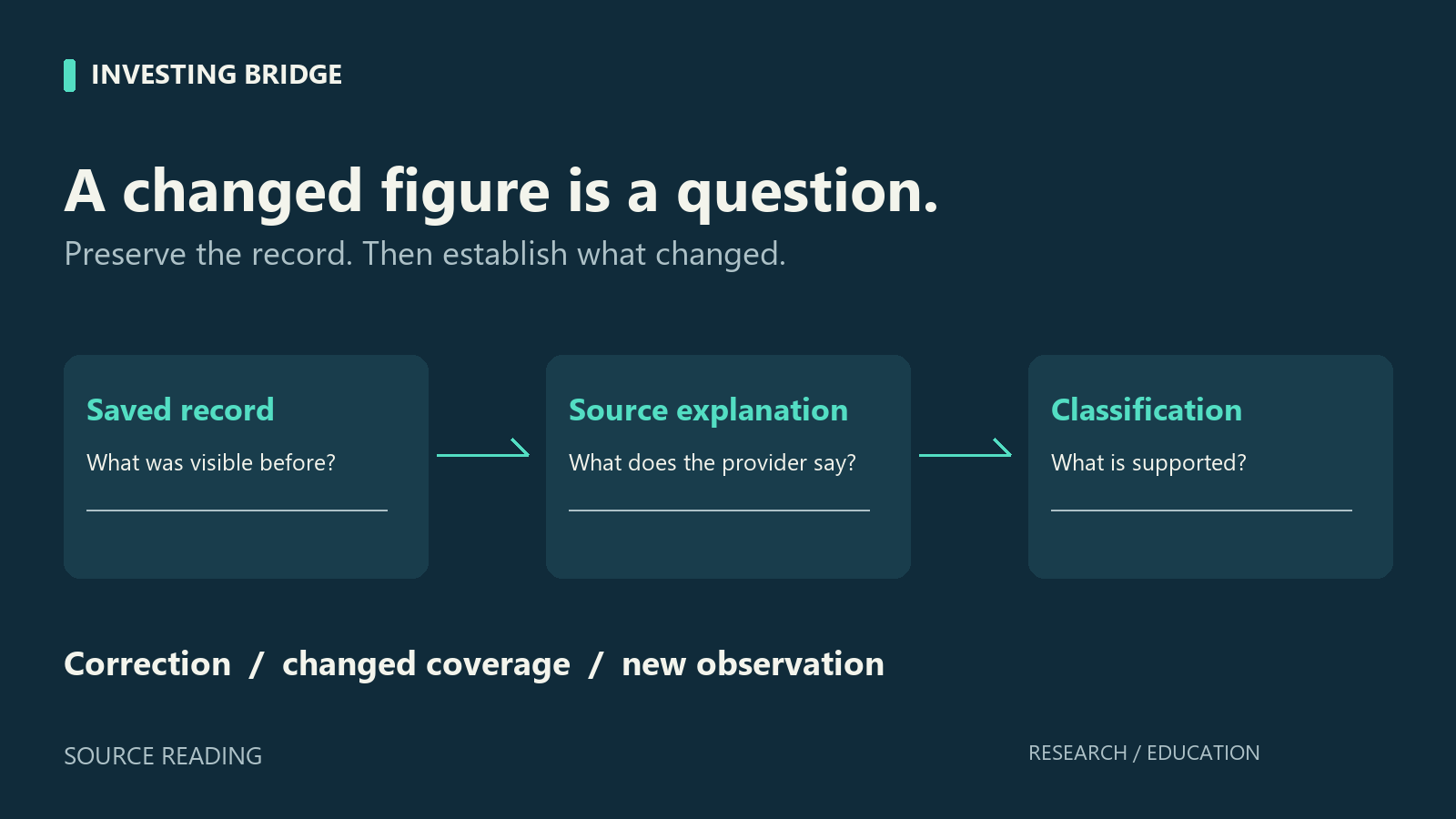

Forex sentiment revisions deserve a clear audit trail because a changed figure can reflect a correction, a change in what the source covers, or a genuinely new observation. These events may look similar when viewed only as values in a table, but they mean different things. Knowing which occurred helps readers interpret the evidence without treating a revised record as though it had always appeared in its latest form.
This is a source-reading method, not a claim that every provider revises information in the same way. A particular source may explain its practices, publish a notice, or provide no explanation visible to the reader. The useful habit is to record what can be verified, distinguish it from what is inferred, and keep unresolved questions visible.
That discipline is relevant to any market sentiment input. A value can be connected to a provider, instrument, observation time and definition. If one of those changes, comparisons with earlier records may need qualification. The goal is not to find a single explanation for every difference. It is to identify the type of change the evidence supports and to avoid silently rewriting the history of a research note.
Forex Sentiment Revisions: Identify What Changed
Check the observation before interpreting the change. Start with the source name and the exact item being compared. Then identify the instrument, population or coverage described, measurement, timestamp, and any displayed definition or methodology. These details establish whether the earlier and later records refer to the same thing. Similar labels alone do not prove that two observations are directly comparable.
Next, ask what changed. Did the source replace a previously published value for the same observation? Did the source change the markets, accounts, categories, or other material included? Or does the later record refer to a different observation time? These questions separate a correction from changed coverage and a new observation. If the source does not provide enough detail to decide, record that limitation rather than assigning a cause.
A correction changes the record of an observation already published. The key idea is that the later value is presented as fixing or replacing information for the same stated observation, rather than describing a later moment. A reader should look for evidence such as a source notice, revision label, corrected file or explanation. Without that evidence, a difference alone does not prove that the earlier value was erroneous.
A coverage change means the later record may include a different scope or apply a changed definition. The source may have added or removed an instrument, altered a category, or changed how it describes the observations it gathers. That does not necessarily mean the earlier record was wrong. It may mean the series now answers a different question or has a different boundary. The change should be described in the source revision context, not passed off as a correction.
A new observation refers to a later point in the source’s stated observation sequence. Its value may differ from an earlier one because it represents a separate observation, not because the earlier value was replaced. Check the source’s timestamp or observation label. A newer publication date by itself may not tell you whether the underlying information is new or whether an earlier observation was revised.
These categories can be recorded without claiming to know more than the source explains. For each update, note the earlier record, later record, time checked, any relevant notice, and the classification you can support. If the explanation is incomplete, label the event “unresolved” and state what is missing. A research note becomes more reliable when uncertainty is explicit rather than concealed behind confident wording.
Forex Sentiment Revisions: Preserve the Earlier Record
When a source changes a previously seen value, preserving the earlier record allows a reader to see what was available at the time. Overwriting it erases the difference between the first publication and the later version. That can make an old analysis appear to have been based on information that was not then visible, even if the writer never intended to imply that.
Preservation does not mean insisting that the earlier figure is correct. It means retaining a traceable copy of what was initially observed, while clearly identifying any later update and its source. If an official source describes a value as corrected, the correction should be acknowledged. The original remains useful as a record of the publication history, not as a competing claim about the best current representation.
A simple record can keep the original item, the updated item, their source references, the observation label, and the times at which each version was accessed. Include the source’s explanation when available. If there is no explanation, say so. The point is not to create an elaborate archive for its own sake. It is to make it possible to tell which version informed a past interpretation.
Keep the update history separate from the analytical conclusion. A correction may affect the figures used in a calculation, but the nature of the correction and its effect on the analysis are two distinct questions. A note can describe the source change first, then explain whether the interpretation needs to be revisited. If the effect cannot be assessed, that uncertainty belongs in the record as well.
The CFTC’s historical special announcements provide an official example of why a source history can matter. The page documents special announcements relating to Commitments of Traders reports. It is useful as a source-specific reference for report history. It should not be treated as proof that every provider follows the same revision process or that any particular forex sentiment source has changed its records.
COT context also calls for careful dating. If a discussion draws on COT, the source observation remains dated even when a research board or article is refreshed. A fresh presentation does not make the underlying report current. Keep the signed Large Speculator NET reading separate from its position within a dated two-year minimum-to-maximum range. That range comparison is not a distribution percentile or a rank, and neither measure should be described as live positioning.

Revised Broker Observations and Source Revision Context
Revised broker observations should be interpreted in the context the broker actually provides. A change in a displayed value can prompt a source check, but it does not, by itself, establish why the value changed. It may be an explicit correction, a change in coverage, a new observation, a display update, or a difference in how the record was retrieved. Avoid treating these possibilities as interchangeable.
Begin by recording the source label and the time at which the observation was seen. Check whether the provider identifies the time represented by the information separately from the time it was displayed or retrieved. If both are available, preserve both. This helps prevent a refreshed page or export from being confused with a newly measured observation.
Then compare the definition. Does the source describe the same instrument, data population, calculation and time basis in both records? If the provider has clarified or altered any of these, note the change in plain language. A difference caused by a definition change should not be reported as a change in sentiment without explaining the revised basis.
For example, a source may change the markets it includes while retaining a familiar label for the series. A reader comparing before and after might see a different value and assume that participants’ positioning changed. But if the coverage changed, the comparison may combine different scopes. The responsible response is to identify the scope change and avoid inferring a market shift from values that are no longer directly equivalent.
Sometimes the source provides only a new display and no accessible revision notice. In that case, do not describe the earlier value as an error or the later one as a correction. State the observable facts: the two records differed, the source information available to you did not explain why, and further confirmation is needed. This language is useful because it preserves the distinction between evidence and assumption.
A concise source revision context note can answer a few practical questions in prose. What source was checked? What record or definition is being compared? What changed visibly? What does the provider say about it? What remains uncertain? Those questions make a correction easier to distinguish from changed coverage or a separate observation, without implying that the source must supply a particular kind of notice.
This is also a useful way to discuss OANDA order and position books. Describe the source and its stated scope rather than extending what a displayed book can establish. A changed observation should not be presented as proof of a participant’s identity, intent, or a guaranteed market response. The guide to reading the OANDA order book and position book offers related context on interpreting that source without assigning it a broader meaning than it supports.
The same care applies when sentiment inputs are compared with other research. A broker observation and a COT report do not automatically share a population, instrument or timestamp. Their agreement does not prove that one validates the other, and a difference does not automatically identify an error. Explain what each source measures, keep its date visible, and use multi-factor confluence as a way to organize distinct inputs, not to erase their individual limits.
Sentiment Version History Without Hindsight
A sentiment version history is a concise account of what was available and when, and of what changed later. It helps a researcher revisit an earlier conclusion without silently applying later information to an older record. It can also help a reader distinguish a source correction from a new observation, even when both are now visible in the same interface.
A version history also makes ambiguity easier to manage. The source may publish a new record without clarifying whether an earlier one was replaced. You can record the new material and note that the relationship between versions is unconfirmed. That is more accurate than calling it a correction, or treating it as an entirely separate observation, before the source basis is clear.
Use precise language when summarizing the history. “The displayed value differs from the earlier saved record” is an observation. “The provider corrected the earlier value” is a stronger claim and requires a source statement or other verifiable evidence. “The coverage appears to have changed” should also be qualified unless the provider confirms it. Small wording choices help prevent an inference from being mistaken for an established fact.
The XAUUSD sentiment research guide provides a related example of keeping source definitions and dates visible when discussing market sentiment. Although the instruments and sources differ, the underlying discipline is similar: name what an input measures, state the time context, and avoid making a broader claim than that input can support.
Research Correction Notes and Uncertainty
Research correction notes should make a change understandable without overstating its cause or effect. A helpful note identifies the earlier record, describes the later information, points to the source evidence, and states what remains uncertain. It should also explain whether the correction changes a calculation or interpretation, when that can be established. If the effect is not known, say so rather than implying that it is immaterial.
Separate the source’s words from the researcher’s interpretation. If a provider explicitly labels a record corrected, quote or accurately summarize that description and link to the relevant source. If the provider merely presents different information, describe the difference without assigning a reason. A correction note should not upgrade a possibility into a finding.
Uncertainty can be specific. Perhaps the source has not explained whether the change reflects a correction or a different scope. Perhaps the observation time is clear, but the method is not. Perhaps the two records can be compared only in part. Naming the missing information tells readers what would resolve the ambiguity and prevents a vague disclaimer from carrying the entire burden.
A correction note should not create a market story. A revised observation does not establish that sentiment has shifted, that a price response is likely, or that the source’s change has predictive meaning. First establish whether the source itself says the record was corrected, the scope changed, or a new observation was published. Then describe only the implications supported by that classification.
In educational market research, source dates and definitions belong beside the interpretation. Investing Bridge’s daily board is published at 09:30 EET and covers EURUSD, GBPUSD, USDJPY, XAUUSD, BTC, S&P500 and WTI. It may consider OANDA order and position books, FX option expiries, CFTC COT and other research inputs through multi-factor confluence. Each source retains its own date and scope; a board refresh does not refresh a stale source.
Frequently Asked Questions
How can I tell whether forex sentiment revisions are a correction or a new observation?
Forex sentiment revisions should be classified using the source’s labels, timestamps and explanation. A correction refers to an earlier observation the source identifies as changed; a new observation has its own observation time. If the source does not clarify the difference, record the uncertainty rather than guessing.
What should revised broker observations include in source revision context?
Revised broker observations should be documented with the source, the observation’s time and definition, the earlier and later records, and any provider explanation. Source revision context should distinguish confirmed facts from assumptions. If coverage or method changed, note that separately from a correction.
Why keep a sentiment version history and research correction notes?
A sentiment version history preserves what was available at different points, helping readers assess older analysis without hindsight. Research correction notes explain what changed, identify supporting source information, and state what remains uncertain. Together they make the record easier to review without treating every difference as an error.
How should I handle forex sentiment revisions when the source explanation is incomplete?
For forex sentiment revisions, preserve both records and state what can and cannot be verified. Revised broker observations may reflect a correction, changed coverage or a distinct observation, but do not label them without support. Keep sentiment version history and research correction notes linked to the source so the uncertainty remains visible.
To see how Investing Bridge presents knowledge-first educational market research, inspect the free daily preview. You can also visit the Investing Bridge homepage. A 7-day free trial is available, then EUR 19 per month. Review the material for its explanations and source context, with no promised profits.
Not financial advice. Trading involves risk.
Investing Bridge provides educational market research, not investment advice. Trading involves substantial risk of loss.